



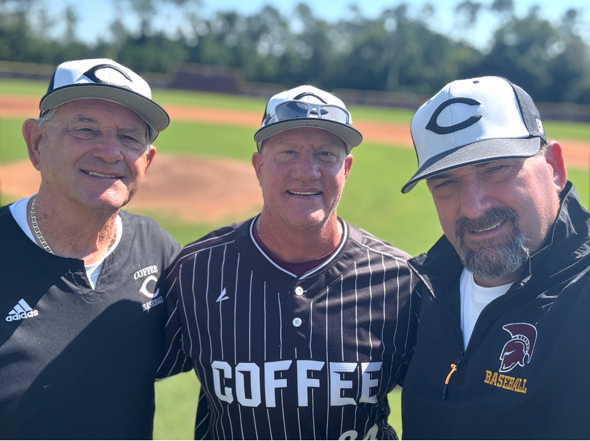
If you google “Greatest high school baseball coaches of all time,” links to several different sites will pop up. The various organizations keep records differently so you might find the names in differing order, depending on the outlet.

One name, however, is on every list – and it’s near the very top – Rich Hofman, the winningest high school baseball coach in Florida and one of the top five or six high school baseball coaches in the country.
Coach Hofman’s list of accolades and achievements is too extensive to discuss in this space. Here are the highlights: 1,020 wins (the most in Florida; an overall record of 1,020-287), 12 state titles, four national championships, 11 national coach of the year awards, national Coach of the Decade 1990-2000 (Baseball America), a member of eight coaching halls of fame, a coach of 67 Major League Baseball draft picks, two first-round selections (Alex Rodriguez and Doug Mientkiewicz, both also World Series winners), and a coach who has sent over 250 players to college.

Why is this important, you might be asking. Because Rich Hofman is now a member of the Coffee High baseball coaching staff. Coffee head coach Scott Grove and Coach Hofman are good friends and go way back from the years Coach Grove spent in Florida. Two years ago, Grove came to Douglas to lead the Trojans. A year ago, Coach Hofman’s son, Dave, joined the Coffee High staff. Now his father, who officially retired as a high school coach several years ago but has remained active in the sport, is on board.
“We’ve been friends for so long. We’ve talked about coaching together for while now. We got Dave here and now Rich is here. It’s something that’s going to be so beneficial for our program,” said Coach Grove last week in the Coffee High fieldhouse.
Dave Hofman has always coached alongside his father as an assistant and has been there for most of the elder Coach Hofman’s biggest moments. Coach Grove currently has 596 wins between Coffee High and his career in Florida. He has also won a Florida state title, a national championship, and been named the ABCA national Coach of the Year (2021). The Trojan players will have two coaches with over 1,600 wins, 13 state titles, and five national championships leading them every day in practice.
Yet all that – it will only get you so far. The numbers are indeed impressive but kids can see right through statistics written on a piece of paper. “You get respect initially from what you’ve accomplished. But that only gets you to day one. You’ve got to prove yourself to your players. You can’t fool kids. If you’re not the real deal, they figure that out pretty quickly,” said Coach Hofman.
All coaches have their own philosophies, their own way of doing things. Coach Hofman calls his Hofball; it’s a system he developed early on and he has adhered to it throughout his career. When he entered coaching over 50 years ago, he went to every clinic, seminar, and workshop he could. Hofman was a sponge – he took volumes of notes, read books, and analyzed what the best in the business did. Then he started tinkering. Hofman experimented with drills here, routines there. He kept what he thought was effective and discarded the rest. Over time, the Hofman system emerged.
It’s the system that won 12 Florida state titles and four national championships. And it’s the same system that he is bringing with him to Coffee High School. Of course, Hofball has to mesh with Groveball, which is a term Hofman coined last Wednesday at the field house. “Our system is our system. It’s unique. It’s just us. It’s Groveball. Mine was Hofball. This is Groveball. I just gave him that name so . . .” he laughed.
Hofman believes in discipline, repetition, preparation, and being fundamentally sound. It’s not a glamorous approach but it is very effective. “I don’t think there’s any substitute for being fundamentally sound in the game. Teaching a kid how to throw properly, field properly, swing the bat properly, run the bases, all the basics of the game – if they’re taught properly, they’ll be successful. They’ll go as far as their talent will take them,” he said.
Hofman added that a big part of his philosophy is discipline: “If you don’t have discipline in a program, you’ll never be successful. I’m a big disciplinarian – but not a mean guy or anything. I just like things done in an orderly fashion and done correctly. So when something isn’t done correctly, there needs to be correction. If you correct a mistake, it won’t happen again. Or it won’t happen very often.”
Hofman’s system is outlined in his memoir Coach of the Decade: Rich Hofman (yes, he has a memoir), authored by Coach Hofman and Richard Davis. He calls it “a clearly defined procedure on how to become the best coach, player, and team that you can be.” It sounds simple – and it is – but the devil, as always, is in the details. Included are such axioms as know your material forward and backward; teach the fundamentals and work on them daily; teach each phase of the game to your players and coaches in the offseason; plan every practice in great detail with groups and times listed and posted in the dugout; assign players to jobs before and after practice and insist on them being done correctly; come dressed properly to practice; hold players accountable for mistakes; make sure assistants do the same; make practices harder than the game so the game will seem easy; tempo and hustle are required for the entirety of practice; cover every possible game situation in practice; teach mental visualization; have a plan and execute that plan; and, of course, just win.
When you read the above, a picture should emerge: That of an uncompromising, relentless, unapologetic, and demanding approach to baseball. Coach Hofman believes that anything rewarding in life is difficult. His methodology certainly fits that description. And its fruits are most definitely rewarding.
Players who commit to Hofball get better. They win. They push through obstacles. They do not quit. And most importantly, their progress exceeds what they ever thought possible. They get better. A lot better.
And ultimately, that’s the goal – to get the most out of a player’s talent. It’s no secret that some players have more talent than others. But there are things that all players can control no matter how gifted they are. “The intangibles are work ethic, discipline, set your priorities, be a good teammate, believe in the system, then go out and outwork everyone else. If you do that, you will go as far as you possibly can go,” said Coach Hofman.
Of course, this new approach is more than Hofball. It’s a convergence of Hofball and Groveball, a merger of the philosophies endorsed by this small collection of elite high school baseball coaches who now ply their craft at Charles Wilson Field.
The Coffee High baseball program is on the precipice of something special. Each practice is its own showcase, an opportunity to be taught by the best. But it will all be for nought if the players do not embrace the system and follow their coaches’ lead.
At the time of this conversation, Hofman had only been in town for a few days. He had seen a few games last year and had some familiarity with the returning players. He just hadn’t had the opportunity to work with the kids for any length of time. Despite the condensed time frame, he already had an idea regarding the strengths and weaknesses of the team – after all, he’s spent a lifetime evaluating baseball players – and he sees some talent. “I was here occasionally last year and I watched some games. I felt there was talent here. So when there is talent then it’s crucial to be able to have instruction that can help them develop. We’re into teaching here. We’re into correcting. We’re into developing them to the maximum of their ability. That’s my goal for every player,” said Coach Hofman.
Coach Grove sees this staff as a turning point for the Coffee baseball program. Some changes will be obvious, others more nuanced. The end result, though, will be a stronger, better prepared, and more potent collection of Coffee Trojan baseball players. “I think the more the players see that we have their best interests at heart and we’re trying to make them the best version of baseball players we can, the more they’ll buy in. I think they’ll respect and understand that,” said Coach Grove.
“I don’t consider myself a coach. I’m a teacher. I taught in the classroom and I teach on the baseball field. For me, baseball is an advanced subject. You can delve so deeply into what the very root of baseball is about. The goal is to make a player realize his full potential, and to do that, you need cooperation. You need his cooperation. We’re here for the kids. We have their best interests at heart,” said Coach Hofman.