



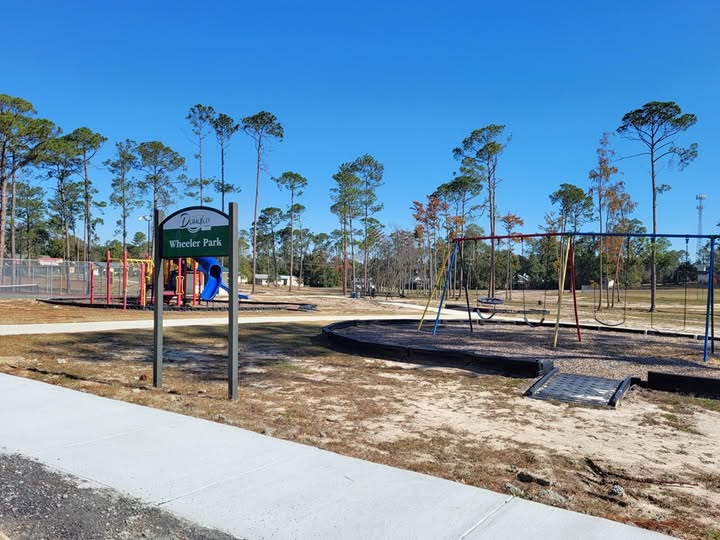
Seven years after residents first shared their hopes for Wheeler Park, and two years after Hurricane Helene leveled its trees and destroyed its playground and shelter, Wheeler Park is ready to welcome the community back. The Community Foundation of Coffee County and the City of Douglas will host a ribbon cutting and grand reopening celebration on Friday, October 16, at noon.

Wheeler Park is a century-old public park in the heart of Douglas. Its revitalization has been led by the Community Foundation of Coffee County and the City of Douglas. This event is seven years in the making. Twice, the work came to a stop: first when the COVID-19 pandemic paused the plan, and again when Hurricane Helene struck days before a scheduled ribbon cutting. Both times, the community picked the work back up.
The Wheeler Park project began with the vision and support of two leaders who loved where they lived.
Francis Lott was an accomplished architect, business leader, real estate developer, and philanthropist from Douglas with a passion for economic development. Douglas sits about 50 miles from an interstate in any direction, and Francis believed the town’s leaders had to take initiative, because “no one is coming for us.” He established a fund at the Community Foundation to support economic development in Coffee County.

Curtis Farrar, a Douglas native, was a second-generation attorney and community leader who helped create General Coffee State Park. Where Francis spoke boldly, Curtis encouraged quietly. He wanted people to think big and then invest to make it happen. He supported a bus tour so that 30 local leaders from Douglas could see what was working in downtown housing and community park redevelopment in Macon-Bibb County. Later, he left a bequest to the Foundation, and the first grant from his bequest helped re-build the New Pavilion at Wheeler Park.
Two very different leaders found common ground in their love for Douglas. Their vision started the work, but it took a whole community of volunteers, partners and donors to carry it through.
The first step was a plan. In 2019, inspired by what they had seen in other communities, local leaders championed a master plan for Wheeler Park, created with Interface Studios. Residents told planners what they loved about the park and what they hoped to change. They wanted elements like an enhanced playground, a widened walking path, and a refreshed shelter. They loved the shade of the tall pines but not the needles and roots underfoot.
Just as the work was beginning, COVID-19 arrived, and the plan stalled. Yet the park was busier than ever. Families needed somewhere to go, and local civic clubs even held their meetings outdoors at Wheeler Park when they could not gather inside.
The Foundation knew the largest improvements would take time. It also did not want residents to think their input had been forgotten. So it launched a “pop-up summer” of simple, low-cost projects taken straight from the master plan:
- A grant to the Boys and Girls Club let children paint rocks and hide them around the park for others to find.
- Hammocks were added to the quieter side of the park.
- A grant to a local artist commissioned a piece of interactive public art.
- A grant to Keep Douglas Beautiful funded volunteers to build and install Little Free Libraries in four parks, creating outdoor reading rooms for children.
In a rural community, there is not always a single nonprofit poised to lead a project like this. The beauty of a plan built on public input is that the ideas came from the community, and so the people were ready to carry them out.
With momentum restored, the Foundation turned to the community’s top request: a new playground. The first and most important step was formally engaging the City of Douglas as a partner. This work absolutely could not have happened without the partnership of the City and its leadership.
Together, the partners commissioned a full site survey of the park, and they hired landscape architect, Wimberly Treadwell, to recommend site-specific play equipment. The City refreshed the park’s original metal play equipment, and the Foundation purchased two new pieces of playground equipment. The City also added new sidewalks around the playground.
In September 2024, the new equipment was installed, and a ribbon cutting was planned for the following week. Then Hurricane Helene struck Georgia.
The storm damaged all of the playground equipment. It leveled the park’s entire tree canopy. It also destroyed the Lions Club Shelter, the gathering place at the center of the park that the Lions Club built in the 1950s. The project stalled again.
Rebuilding With Intention
The storm could have ended the project. Instead, it set the stage for something better.
A new canopy. Before Helene, the park was filled with pine trees. They gave shade, but their shallow roots and fallen needles made the ground hazardous underfoot. The master plan had already called for removing some pines near the playground, and the storm removed far more. Board member Kevin Koeppler, General Manager of Sunbelt Greenhouses, led the replanting, and Hahira Nursery provided the new trees. The partners chose the number, placement, and species of more than 60 new trees with care, so the park will have beauty and shade that lasts for generations.
A restored playground. The new playground equipment that the storm damaged was repaired, and the playground was restored for the children it was always meant to serve.
The Pavilion. To replace the Lions Club Shelter, a new structure, The Pavilion, was built from the ground up, and the Douglas Lions Club was instrumental in supporting the rebuild. The committee chose a new site a little farther up the hill, on more level ground closer to the bathrooms, tennis court, and playground. The Pavilion now overlooks a green space, so it can host concerts, ceremonies, and more. It was designed by Isabel Humphries, a Georgia Tech Master’s of Architecture student and the daughter of Foundation Board Chair Melissa Humphries, one of the project’s leaders. Isabel’s connection to this story runs deeper still. Francis Lott was a proud Georgia Tech alumnus who regularly wrote letters of recommendation for Douglas students applying to his alma mater. The last letter he wrote before he passed away was for Isabel. She was accepted and is now in her final year of the program. When the committee needed someone to design The Pavilion, it was only fitting to ask her. Her design draws on Francis Lott’s architectural style while honoring how the community uses the space and the natural setting of the park. It is a true full-circle moment for Douglas.
In September 2026, the Wheeler Park story was shared at the Georgia Grantmakers Alliance Annual Meeting in Tifton as a model for rural philanthropy. Its lessons reach well beyond one park, and the most important one is the simplest: the community did not give up.
In small communities, philanthropy and economic development are tied together more closely, and more visibly, than in large cities. When there is no single local nonprofit to give to, a funder has to work differently. It must listen first, partner with local government, test ideas before committing major dollars, and stay the course when plans fall apart.
Wheeler Park would not look the way it does today without the partnership of the Community Foundation of Coffee County and the City of Douglas. The project’s greatest strength was always its people. Every phase of this project depended on volunteers and partners who kept showing up. When the pandemic stopped the work, and again when the hurricane did, they refused to give up.
When different people and organizations unite around a common goal, the entire community benefits. Bringing those people together is what a community foundation does best, and it is the greatest value the Foundation added to Wheeler Park. Every gift made through the Foundation stays close to home, and in a place like Douglas, the results are visible to everyone and will last for generations.
A legacy that lasts. Neither Francis Lott nor Curtis Farrar lived to see this ribbon cutting. Yet the work they set in motion carried on, through the volunteers who picked up where they left off and through the Community Foundation that kept their gifts at work. Curtis’s legacy fund helped build The Pavilion. Francis’s last letter of recommendation led, years later, to the young architect who designed it.
If you love where you live and want to make it a better place for the next generation, the Community Foundation of Coffee County is the place to start. Partnering with the Foundation ensures that your effort, and your personal legacy, will be carried forward long beyond your lifetime.
