



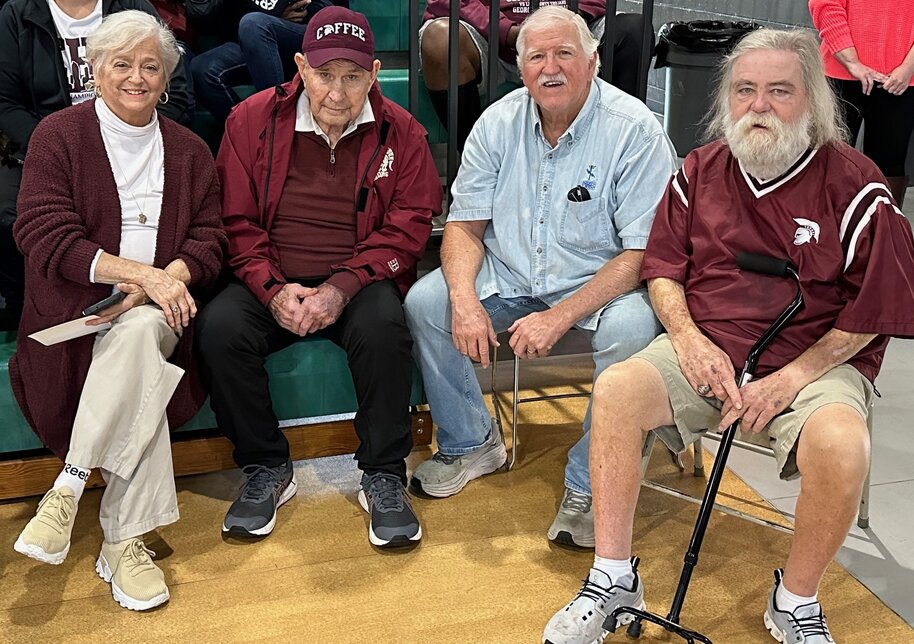
I have known Walter Jardine my entire life. I grew up listening to my grandparents and my dad talking about Dr. Dan Jardine, Walter’s father. For the first third of my life, I knew Walter primarily as a teacher and a coach. I also knew that he was the local photographer, always at every game – it didn’t matter which sport, and always with a camera in tow.

When I was in the 11th grade, I realized that I wanted to make my career as a newsman. I loved writing. I loved access. I loved being a part of (and helping frame) issues affecting the community.
My career path in the news put me under the same roof as Jardine, which is how I will refer to him from this point forward. In addition to teaching and coaching, Jardine also served as a sportswriter and photographer for The Douglas Enterprise. I worked at The Enterprise off and on while I was in college and again for two years after I graduated.

When I was at the paper, I worked alongside Jardine. I was strictly a news writer. I didn’t do anything with sports and as such, I never worked closely with Jardine.
I did, however, observe how he worked. We talked regularly and he shared with me how and why he did his job the way he did. It is also worth mentioning that Tom Frier Jr. was the editor of The Enterprise during this time. Together, Tom and Jardine became my mentors. Tom taught me what was newsworthy, how to write engaging stories, the importance of grabbing readers’ attention, and maybe most importantly, how a newspaper connected with and served as an extension of the local community.
Jardine reinforced those same lessons but he did so from a sports angle. To Jardine, the world of sports was a vehicle through which the community celebrated its successes. In many cases, student-athletes represent a community far more effectively (and with a greater reach) than anyone else can. Jardine also wanted to give the kids the credit they deserved for their hard work and sacrifices they made so they could compete with the best in the state.
People have an academic knowledge or some vague recognition of the breadth and depth of Jardine’s job. What they don’t realize is the amount of work that went into the service he performed.
Yes, finding the time to go to the games was painstaking enough. But the real work began – and continued – long after the stadium lights went out and fans returned home. Being on the sidelines for games looks glamorous. If, however, you do the job way you’re supposed to, it’s anything but that.
Once the game ended, it was time to go through the pictures. Digital photography is still relatively new. For much of Jardine’s career, he took pictures and developed those pictures the old-fashioned way – with film, in a darkroom, developing photos by hand.
This was particularly difficult on Friday night. The Enterprise held the paper on Friday nights so readers would have a game report on Saturday morning. The deadline was tight and much of the newspaper staff worked into the wee hours of Saturday morning to get the paper out on time.
Jardine would take his rolls of film into the darkroom, develop the film, then try to find the best pictures to develop. Once he did that, he would send the photos to the pressroom to be re-shot in a format for the paper. At the same time, the writer was working on the story while Tom handled the layout. Everyone was on a firm deadline. It was doable for a home game. An away game – that was a different story. Those were struggles.
Baseball, basketball, and other sports gave Jardine a little more flexibility but the work was still grueling.
In the mid-90s, the sports photos were still developed in-house in The Enterprise’s darkroom. Jardine showed me how to develop pictures in there. I could do it but it wasn’t easy. And it took me a long time. That experience gave me a newfound respect for the job he did.
A few years later as digital photography replaced film, things got easier. But don’t think that means that the work went away. What digital allowed Jardine to do was take even more pictures. The number of photos he could take was only limited by his battery life and the cards he used. Consequently, Jardine had even more photos to go through. Then he had to size and tone them for publication.
Painstaking doesn’t begin to describe the process.
Jardine did this year after year, season after season, for decades. Multiple generations of kids grew up seeing themselves in print because of his tireless dedication.
Around 2005, I reluctantly started photographing and writing about sports. I wasn’t a sportswriter then and I’m not sure that I’m one now, though I continue to perform that task.
I never had the opportunity to work with Jardine as a sportswriter. There certainly would have been no need for me to pick up a camera with him on the job.
Jardine never ostracized me or snubbed me, even though for the last 20 years, we have worked for competing publications. I would often see him on the sidelines and we always talked. We developed a friendship at The Enterprise and that friendship remained even if we weren’t working together.
I never told Jardine this but I’m absolutely 100 percent sure that he knew what I was doing. When I started taking pictures, I followed him around the stadium. Wherever he went, I went. I learned the best spots in the park to stand, the places where the lighting was good (believe it or not, but there are areas of Jardine Stadium that are as dark as a closet, even with the lights on), the angles to take, everything.
I tried to copy what he did.
Here’s the thing, though. I couldn’t do it. Taking pictures is more than knowing where to stand or what camera setting to use. It’s about framing the shot, capturing the moment, and doing so in way that tells a story all on its own. That’s where Jardine’s true strengths came through.
He captured the receiver’s eyes as he reached for a pass with a defender closing in. You could see the intensity in a linebacker’s expression as he readied for a bone-jarring collision. You could see a basketball player’s concentration as he or she scrambled for a loose ball. He froze a baseball as it met the bat or suspended a fielder in the air as he dove for a line drive.
Jardine told the story of a game through the lens of his camera. That’s something I never figured out how to do. I still struggle with it to this day.
As I sit here and look back at the last 30 or so years, I see Jardine’s influence on so much of what I do. One of the best ways for a local newspaper to engage the community is through local sports. And as important as the stories are, photographs reveal the story lines and humanize games in a way that words simply cannot.
Jardine was the best at what he did. He knew it but he didn’t hoard it. He shared his expertise with others. Jardine knew a day would come when he would no longer be able to perform the work he so enjoyed and valued. I think he wanted to make sure someone would be there continue the job he perfected over nearly 50 years on the sidelines.
When Jardine passed, I wrote in a short post that we had lost a giant. I stand by that. In fact, in a family of giants, Walter Jardine may be the most significant of them all.
Services for Walter Jardine will be held Thursday, June 11, 2026, at the Coffee High School Performing Arts Center. Visitation will take place from 1 p.m. to 2 p.m. with the funeral service beginning at 2 p.m. Jardine was 78 years old. Sims Funeral Home is in charge of the arrangements.
